
【專題演講】Gender Inequality in Academia: A Longitudinal Study of South Korea and Taiwan (2008-2023)
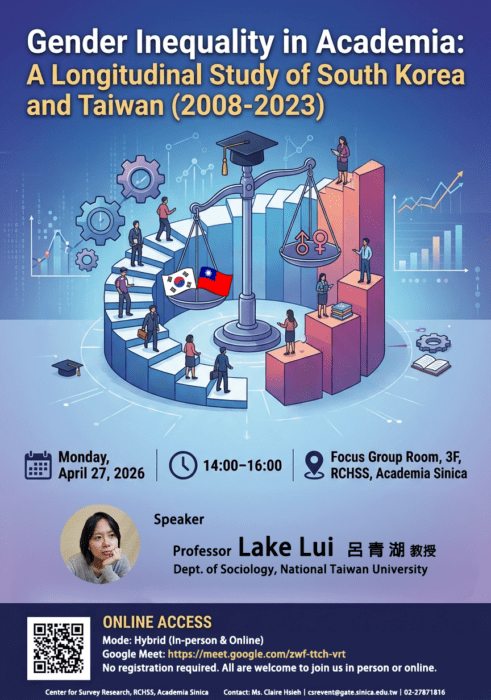
講題:Gender Inequality in Academia: A Longitudinal Study of South Korea and Taiwan (2008-2023)
講者:呂青湖教授/國立臺灣大學社會學系
日期:2026年4月27日(一)
時間:14:00-16:00
地點:中央研究院 人文社會科學研究中心前棟三樓 焦點團體室
Google Meet 線上同步:https://meet.google.com/zwf-ttch-vrt
摘要:
Lake Lui (National Taiwan University) and Lanu Kim (Korea Advanced Institute or Science and Technology)
This paper examines gender inequality in academia in South Korea and Taiwan from 2008 to 2023, analyzing how national gender policies, academic capitalism, and global ranking regimes influence women’s representation across ranks and disciplines. We compile and construct a novel longitudinal university–year dataset from South Korea’s University Information Disclosure system (대학알리미) and Taiwan’s Ministry of Education, enabling us to track the proportion of female faculty members by position (assistant, associate, full professor) and by discipline (STEM vs. non-STEM) among universities included in QS rankings.
Findings show that women’s representation has increased in both countries but with divergent patterns. South Korea’s targeted interventions—such as the Act on Fostering and Supporting Women in Science and Technology and WISET initiatives—produced sharper gains, particularly among junior faculty and within STEM, although horizontal and vertical segregation persist. Taiwan’s broader gender mainstreaming policies yielded more limited effects, with increases concentrated at senior ranks while stagnating at the entry level. Across both contexts, women remain significantly underrepresented in STEM fields. Contrary to expectations, international university rankings exert no clear linear effect on gender composition. In South Korea, however, a non-linear pattern emerges: middle-ranked universities employ higher proportions of women compared to both top- and lower-ranked institutions, suggesting differentiated institutional responses to ranking pressures.
These findings highlight how national policy design and institutional logics of academic capitalism interact to reproduce or mitigate gendered hierarchies. By comparing two Confucian-influenced societies with divergent equality strategies, this paper advances understanding of the uneven pathways toward gender parity in academia and underscores the continuing structural challenges, particularly in STEM disciplines.
講者介紹:
Lake Lui is a Professor in the Department of Sociology at National Taiwan University. She is also affiliated with the Taiwan Social Resilience Center at National Taiwan University and the Center for Studies in Demography and Ecology (CSDE) at the University of Washington. Her research explores how global forces such as economic restructuring, migration, and sociocultural changes interact with national policies to shape gender relations and family dynamics in Asia. Her major publications have appeared in Social Forces; Sociology; International Migration Review; The Sociological Review; and Social Science Research. She is also the author of Re-negotiating Gender: Household Division of Labor when She Earns More than He Does (Springer).
Lanu Kim is an Associate Professor in the School of Digital Humanities and Computational Social Sciences at KAIST, with joint appointments in the School of Computing and the Graduate School of Data Science. She received her PhD in Sociology from the University of Washington and completed postdoctoral training as a Data Science Scholar at Stanford University. Her research uses big data, natural language processing, and advanced statistical methods to examine academic knowledge creation, search-engine influence, and inequality in higher education. Her major publications appear in Social Networks, Scientific Reports, and Sociological Science.
主辦單位:中央研究院人社中心調查研究專題中心
聯絡人:謝小姐 | | (02)2787-1816